- KISS (Keep It Simple, Stupid): Design solutions as simply as possible. Avoid unnecessary complexity.
- DRY (Don't Repeat Yourself): Eliminate duplicate code. Centralize logic to make maintenance easier.
- YAGNI (You aren't Gonna Need It): Build only what's needed now, not features you might need "someday."
- Encapuslate what Varies: Hide changing parts of your code behind stable interfaces.
- Program to an Interface, Not an Implementation: Depend on abstractions, not concrete classes, for flexibility.
- Favor Composition Over Inheritance: Combine small, reusable components instead of relying heavily on class hierarchies.
- Strive for Loosely Coupled Designs: Reduce interdependencies so changes in one part don't break others.
- LoD (Law of Demeter): Only communicate with direct neighbors. Don't chain too many calls.
- SRP (Single Responsibility Principle): One class, one job—keep responsibilities clear and focused.
- OCP (Open/Closed Principle): Open for extension, closed for modification—add new features without changing core code.
- LSP (Liskov Substitution Principle): Subclasses should seamlessly replace their parents without issues.
- ISP (Interface Segregation Principle): Create small, specific interfaces instead of large, general ones.
- DIP (Dependency Inversion Principle): Depend on abstractions, not details—high-level modules shouldn't depend on low-level modules.
- Event Sourcing
- CQRS
- Saga
- BFF
- API Gateway
- Strangler
- Database per mictoservice
- Externalized configuration
- Consumer-Driven contract tracing
- Circuit breaker: When a service experiences repeated failures, the circuit breaker 'trips' & stops sending requests to that service for a period of time. This allows the failing service to recover without being overwhelmed.
- Retry: When a request fails, the system automatically retries it a certain number of times before giving up. Improves system availability and can mask transient errors.
- Timeout: Sets a maximum time limit for a request before is considered a failure.
- Bulkhead: isolates different parts of an application into pools or compartments. This isolation limits the impact of failures or overload in one compartment, preventing it from cascading and affecting the entire system.
- Rate Limiting: Controls the rate of incoming requests to protect a system from being overwhelmed.
- Fallback: Provides an alternative (often less ideal) response or action when the primary one fails.
- Hedging (Redundancy): Sends duplicate requests to multiple identical services and uses the fastest response. Mitigates the impact of slow responses and failures, improving system responsiveness.
- Load Shedding: Drops non-critical requests when a system is overloaded to protect its core functionality.
- Backpressure: Feedback loop between the producer (sending data) and the consumer (receiving data). The consumer signals its capacity to the producer, allowing the producer to adjust its output rate dynamically.
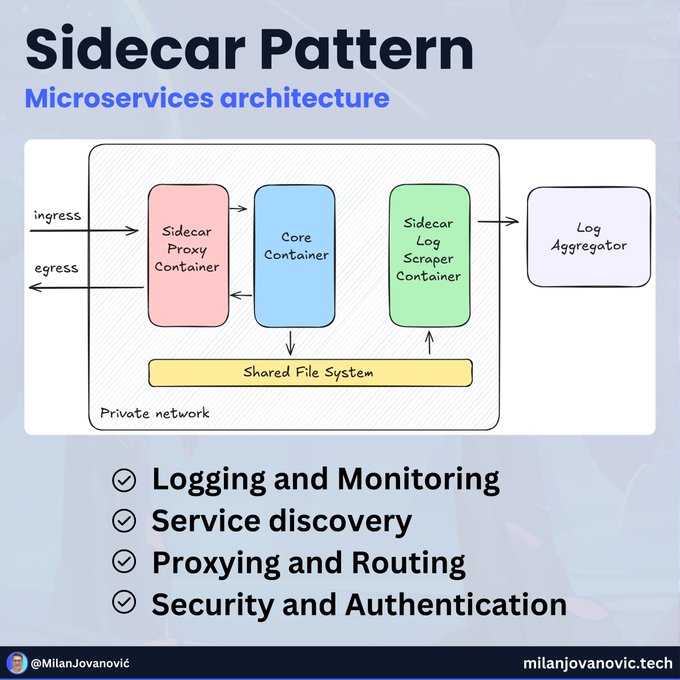
Key Benefits:
- Separation of cross-cutting concerns (logging, monitoring, security)
- Language/framework agnostic - can be written in any tech sta
- Independent scaling and updates of aux. components
- Reduced main service complexity
We need to identify weaknesses before they manifest in system-wide, aberrant behaviors. Systemic weaknesses could take the form of: improper fallback settings when a service is unavailable; retry storms from improperly tuned timeouts; outages when a downstream dependency receives too much traffic; cascading failures when a single point of failure crashes; etc. We must address the most significant weaknesses proactively, before they affect our customers in production. We need a way to manage the chaos inherent in these systems, take advantage of increasing flexibility and velocity, and have confidence in our production deployments despite the complexity that they represent.
Frameworks:
- Fast: Tests should execute quickly to allow frequent execution without slowing down development.
- Isolated: Each test should be independent, meaning the result of one test should not affect another.
- Repeatable: Tests should produce consistent results regardless of external factors such as time, environment, or network conditions.
- Self-Validating: A test should clearly indicate a pass or fail status without requiring manual interpretation.
- Thorough/Timely: Tests should cover all edge cases, not just the happy path.